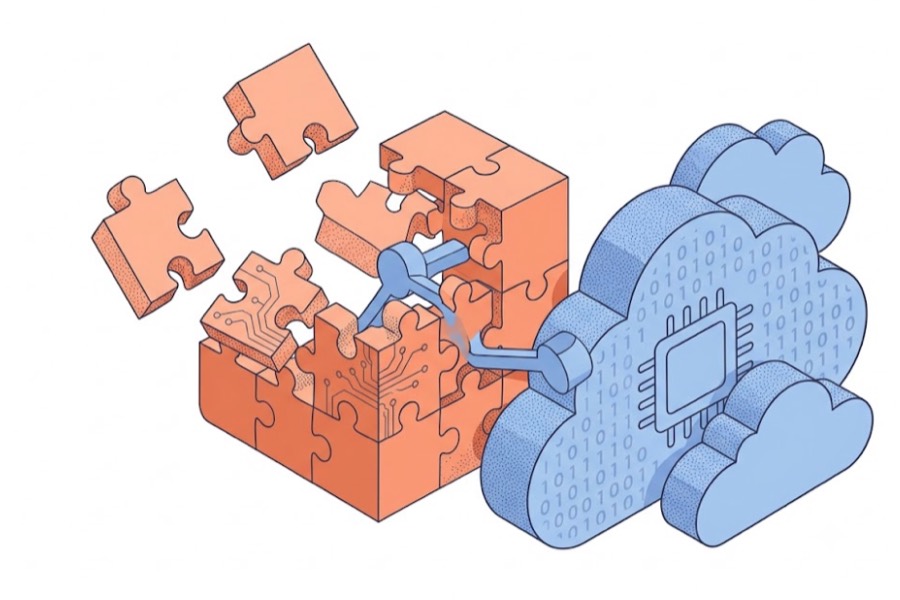
Five disconnected tools don't become one system by adding integrations between them. They become one system when client, project, and finance data start in the same place.
The hand-off problem
A design agency split across time zones runs on hand-offs. A designer finishes a brand system at midnight her time. An account manager picks it up six hours later, with no idea if the client signed off on round two.
Project status lives in one tool. Client billing lives in another. The asset library lives somewhere else entirely — a shared drive, or a Figma project nobody quite trusts.
Most design agency founders notice this around the time their team stops fitting in one room — somewhere between client five and client fifteen.
Ask where a specific client's rebrand actually stands, and the answer depends on who you ask. The designer knows the file status. The account manager knows what was promised on the call. Nobody has both, plus the invoice status, in front of them at once. That's exactly the gap a dedicated invoice tracker closes before the rest of the system catches up.
Each tool was added to solve one problem — a place for files, a place for tasks, a place for invoices. The disconnect between them is where things slip: a revision round nobody logged, an invoice sent for work that hasn't been approved yet.
When client, project, and finance data sit in one workspace, that gap closes. An account manager can see the brand system's current revision round, the deadline, and the outstanding invoice, without pinging the designer or digging through a shared drive.
It also changes how clients experience the agency. A status update doesn't require a meeting — it's already accurate, because it comes from the same record the designer is working from.
This is one piece of a bigger picture: the five operating layers every design agency actually needs to manage — clients, projects, people, finances, and strategy. The cloud-based part is what makes those five layers behave like one.
Three things most tools miss
A cloud-based agency management system needs to do three things a typical design tool stack doesn't.
It has to link the client record to the project automatically — not duplicate the same client details across a separate customer management system, a project board, and an invoicing tool.
It has to track design work the way design agencies actually operate — revision rounds, handoff specs, asset libraries — not generic task cards built for software sprints. Most project tracking software assumes engineering workflows, not creative ones, which is how the margin problem most design agencies don't see coming gets started.
And it has to be reachable wherever the team is. A designer working from a laptop at 11pm needs the same client context an account manager sees from the office the next morning. If the system only behaves well in one place, the agency is back to chasing updates.
This is the gap most agency management tools leave open. They handle one layer well and assume the rest will connect on their own.
What it looks like in practice
Agency OS runs as a connected Notion workspace where the client record, the project, the revision round, and the invoice all reference the same data. Update the project status, and the client's billing and portal reflect it immediately.
Where to start
Pick one active client. Move their brief, their current revision round, and their invoice status into a single record — and notice how much faster the next status update takes to answer.